
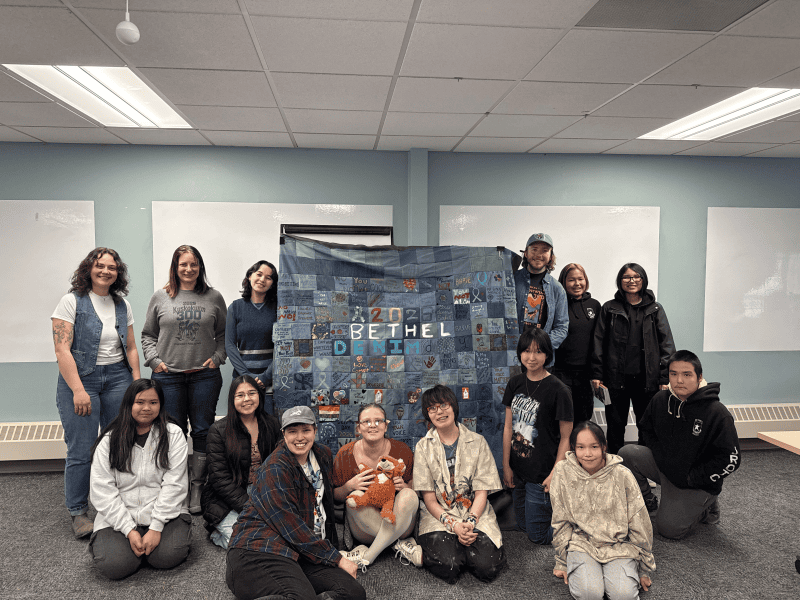
Photo Description: Teens Acting Against Violence (TAAV) in Bethel show off the community quilt they made to celebrate “Denim Day” and show support for survivors of sexual assault. Photo courtesy of Tundra Women’s Coalition and TAAV.
In Bethel, Teens Acting Against Violence lead the way
Eileen Arnold remembers Bethel’s first-ever Pride Parade. As the executive director of Tundra Women’s Coalition and a longtime Bethel resident, she knows the people who regularly attend the organization’s events. But she saw something different at Pride.
“It’s a particular crowd that usually shows up for our events. But I remember looking around and being like, these are new people. These are LGBTQIA2S+ community members. Our youth had really created a space for a population in this community that did not exist before,” she said.
“Our youth led the way on that.”
The Bethel youth who participate in Teens Acting Against Violence (TAAV) are used to blazing trails. The student-led group grew out of Tundra Women’s Coalition, which provides safe, empowering services for families experiencing domestic or sexual violence and runs a women’s shelter and a crisis hotline. TAAV focuses on reducing violence in the community, primarily through peer education. The group started in the early ’90s when local teens took note of the amount of bullying happening in their school and decided to do something about it. Since then, TAAV has established itself as the coalition’s premier violence prevention program. It has also become Bethel’s only sanctioned LGBTQ+ safe space.

Teens take the lead
Aiden Jackson has a plan for when school starts. He’s going to get to class before anyone else so he can privately tell his new teacher his preferred name.
“I’m scared they’ll go, ‘No, I won’t do that. You’ll always have [your other] name in my class. You’ll always remain that gender to me,’” he said.
It’s happened before. As a trans teen, Aiden has had difficulty finding acceptance. At TAAV, though, everyone is welcome.
Aiden joined TAAV when his friend did, as an 11-year-old who heard the youth organization was running a Dungeons and Dragons game at the library. Today, he’s 14, and like other TAAV members, he’s involved in educating other teens about healthy relationships and violence prevention.
“We don’t say bad words or slurs or mean stuff to each other, and I really love that part. Everyone calls you your pronouns you identify as, which is great,” he said.

Because TAAV is a sanctioned safe space, it attracts a lot of LGBTQ+ young people. In turn, they help fuel the events and activities TAAV supports, said Youth Services Manager Taylor Finley.
“The youth drive the bus. They tell us what they’re interested in, and we do the best we can to meet those needs,” they said.
Pride is a good example: Teens pointed out that nothing “queer-specific” was happening in Bethel, Finley described. So TAAV youth started the annual Pride Parade. TAAV member interests drive most of the organization’s activities, from Teen Dating Violence Awareness Month and the annual Missing and Murdered Indigenous People’s march, to creating videos and public service announcements, to traditional Yup’ik activities, to educating their peers.
“Anything that isn’t violent is violence prevention,” Finley pointed out. “Getting to say yes and continue to encourage this group to be creative and to dream big — it’s so powerful.”
Positive peer pressure
Arnold knows TAAV has a good thing going every time she overhears teens like Aiden teasing each other.
“I remember one of the teens was joking, saying, ‘I was going to beat them up.’ And then another teen was like, ‘Hey, we’re teens acting against violence!’” she recalled.
It was a funny moment. But it was also an example of how TAAV teens become positive influences on each other and on their community.
Since its inception, TAAV has empowered young leaders to promote violence prevention through peer education. TAAV members become subject matter experts through presentations from adult mentors and guest speakers. In turn, they provide outreach and education to other youth, reaching up to 1,000 Alaska youth each year in Bethel and surrounding communities.
“Youth really listen to each other,” Arnold said. “As much as we want to look to adults to have the education and the content, youth listen to youth. Peer pressure can be positive or negative, but it is, I think, the most impactful thing.”
TAAV peer education has had influence beyond local schools, she added. Community-wide, people know what TAAV is and what it stands for. Each year, the group also tries to visit neighboring communities to bring peer education to other schools; previously, TAAV has made visits to Goodnews Bay, Kwethluk, and Tununak. Lately, high travel costs and tight budgets have made these partnerships with other villages challenging.
Technology has helped TAAV teens promote their message. The youth have made TikToks about healthy relationships, and they share TAAV-created videos with other schools, even when they can’t visit in person. “Shifting to that digital mindset, it’s not as impactful, but it is important to make sure resources are available one way or another,” Finley said. “And TikTok is what young people listen to. The ability to share the way teens phrase things in ways that are more colloquially understandable — the impact of that cannot be overstated, when it’s coming from a peer perspective.”
Ripple effect
Now that TAAV has a dedicated Teen Center, the organization occasionally opens events to anyone in the community to foster stronger connections and highlight how violence prevention efforts can increase resiliency, prevent trauma, and lead teens toward an adulthood free of violence.

Working with both the coalition and TAAV, Arnold has seen young people go from living with a parent at the women’s shelter, to participating in the Tundra Women’s Coalition children’s program, to being part of TAAV — even to becoming a coalition employee. This continuum, she said, creates long-lasting relationships that serve as a counterbalance against Adverse Childhood Experiences, or ACEs, that can have long-term negative impacts on young people into adulthood.
“The thing about Bethel and other parts of rural Alaska is you get to know people so well,” she said. “Your relationships are really strong because all we’ve got is each other. At TAAV, it’s giving teens people in their life who care about them and get them engaged in other protective factors.”
The work TAAV youth do and the example they set sends ripple effects throughout their community, said Claire Snyder, a Jesuit volunteer who works with TAAV. Because the teens grow so accustomed to talking openly about hard topics, subjects people usually avoid in conversation become normalized at TAAV — and beyond.
“Their vocabularies switch over time. Seeing how consent and violence prevention has become just a normal topic in community has been something really beautiful to watch,” she said.
“It’s so uplifting to see them […] continue to spread that information out through their circles of support and their families,” Arnold added. “One person does have a lot of influence on a lot of other people.”
Tundra Women’s Coalition is most recently the recipient of a $30,000 strategic Housing and Homelessness grant awarded in 2026.
How it works
Three steps to starting your own youth-led organization:
- Follow their lead: “Listen to what teens are interested in and fill in the gaps,” suggests Finley. Youth know what they wish their community offered; ask them what’s missing, and start from there.
- Get community buy-in: Look to community-based organizations to host your youth-led group. “They’re the ones who are invested, interested, and local,” advises Arnold.
- Keep it fun: “Our ratio is two-thirds fun and one third education,” Finley describes. Teens get to be community leaders while still having the opportunity to be kids.


Share This Post